Shiftmate
Standard recipe card Excel template
Scale restaurant recipe to target serving; Record cost, allergens, preparation, portioning and service standard, including wastage.
Prepared by:Shiftmate Product and Operations Team · Son kontrol:
Actual file previews
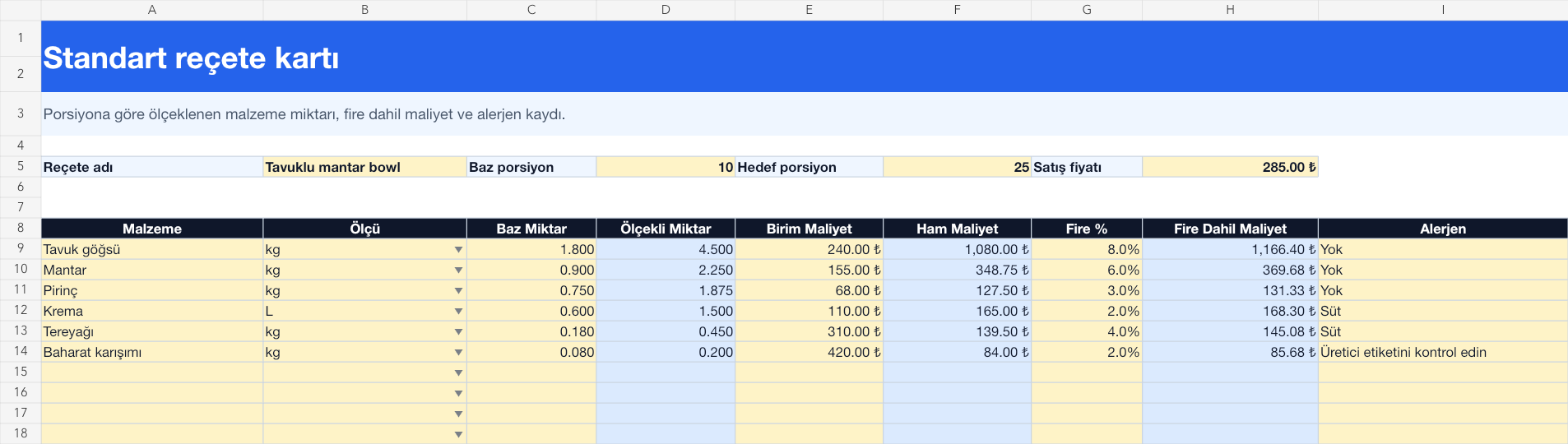
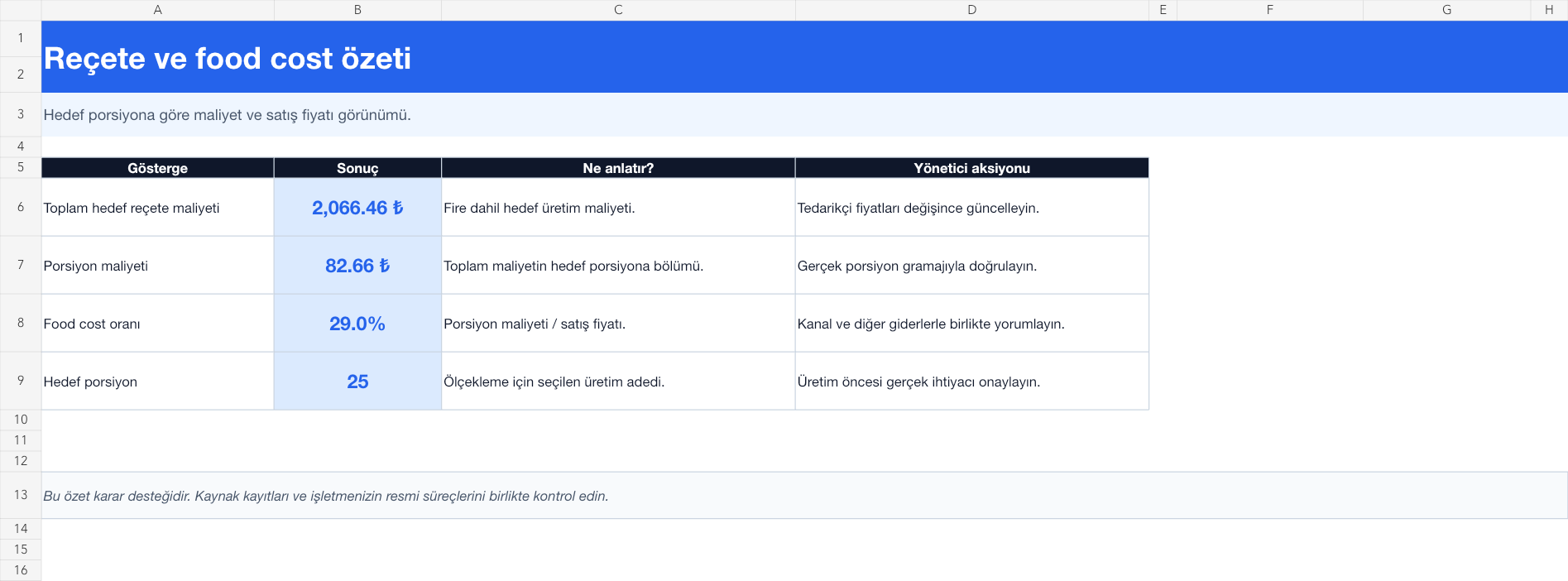
The images below are the actual data entry and executive summary pages of the workbook to be downloaded.
Step by step usage
Prepare the file according to your business
Enter the recipe name, base and target portion, selling price, and unit of measure, base quantity, unit cost, waste, and allergen information for each ingredient. Do not enter costs without converting units of measurement to the same purchasing and usage unit. On the standards page, write down equipment, preparation, cooking, serving, serving, storage, and allergen verification.
Run formulas and checks
Scaled quantity is the base quantity multiplied by the target portion to base portion ratio. Raw cost is the multiplication of the scaled quantity and unit cost, and the cost including wastage is the increase of the raw cost by the wastage rate. The portion cost is calculated by dividing the total prescription cost by the target portion; The food cost ratio is created by dividing the portion cost by the sales price.
Turn results into action
Review the indicators on the summary page. Update the cost when the supplier price changes. Compare the actual serving weight with the standard. Transfer allergen and service information to shift team.
What does this Excel file solve?
Scale restaurant recipe to target serving; Record cost, allergens, preparation, portioning and service standard, including wastage. Enter the recipe name, base and target portion, selling price, and unit of measure, base quantity, unit cost, waste, and allergen information for each ingredient. Do not enter costs without converting units of measurement to the same purchasing and usage unit. On the standards page, write down equipment, preparation, cooking, serving, serving, storage, and allergen verification.
What's inside the file?
Portion scaling, Recipe cost including waste, Food cost summary, Preparation and service standard. The file contains sample rows, canned formulas, data validation fields, risk colorings, and executive summary.
Calculation and control logic
Scaled quantity is the base quantity multiplied by the target portion to base portion ratio. Raw cost is the multiplication of the scaled quantity and unit cost, and the cost including wastage is the increase of the raw cost by the wastage rate. The portion cost is calculated by dividing the total prescription cost by the target portion; The food cost ratio is created by dividing the portion cost by the sales price.
Worked example: scaling a 10-serving recipe to 25 servings
Base portion: 10. Target portion: 25. Sales price: 285 TL. Result: Materials scale by a factor of 2.5; The target recipe cost, including wastage, is 2,066.46 TL, the portion cost is 82.66 TL, and the food cost is approximately 29 percent. The team verifies the portion weight and supplier price before starting production.
Decisions that can be taken as a result of this
Update the cost when the supplier price changes. Compare the actual serving weight with the standard. Transfer allergen and service information to shift team
Common usage mistakes
Multiplying kilograms and grams by the same unit price. Adding waste twice to both quantity and cost. Publishing allergen information only from the prescription file
Limits and proper use
The template is prescription standard and cost support. Actual product yield, energy, labor, packaging and overhead costs should also be evaluated. Food safety and allergen declaration must be verified with the prescription, supplier label and authorized procedure.
Compatibility and quality control
All 67 workbooks underwent formula error scanning, recalculation checking, and page-by-page visual inspection. Standard .xlsx file; Does not contain macros or external links. Formulas and data validation fields run inside the file. It is recommended that you keep the original file and work on a separate copy for your business.
Transitioning from Excel to automation
Use the file to solve restaurant operation needs immediately. When registration and approval traffic grows, move the same process to the Shiftmate workspace.
Relevant official and technical resources
Frequently asked questions
What is the difference from the existing food cost file?
Food cost file mainly focuses on cost calculation. The standard recipe card also keeps scaling to target serving, preparation, equipment, portioning, serving, storage and allergen standard in the same workbook.
If the unit cost is kg, how do I use the gram quantity?
Convert quantity to kilograms or convert unit cost per gram. Quantity and price units in the same row must be the same.
Does the food cost ratio show net profit?
No. It is just the ratio of the entered material cost to the sales price; Labor, rent, energy, commission and other expenses may not be included.