Shiftmate
Price list Excel template
Automatically calculate the sales price with target margin, price including VAT and update status from the product and service cost.
Prepared by:Shiftmate Product and Operations Team · Son kontrol:
Actual file previews
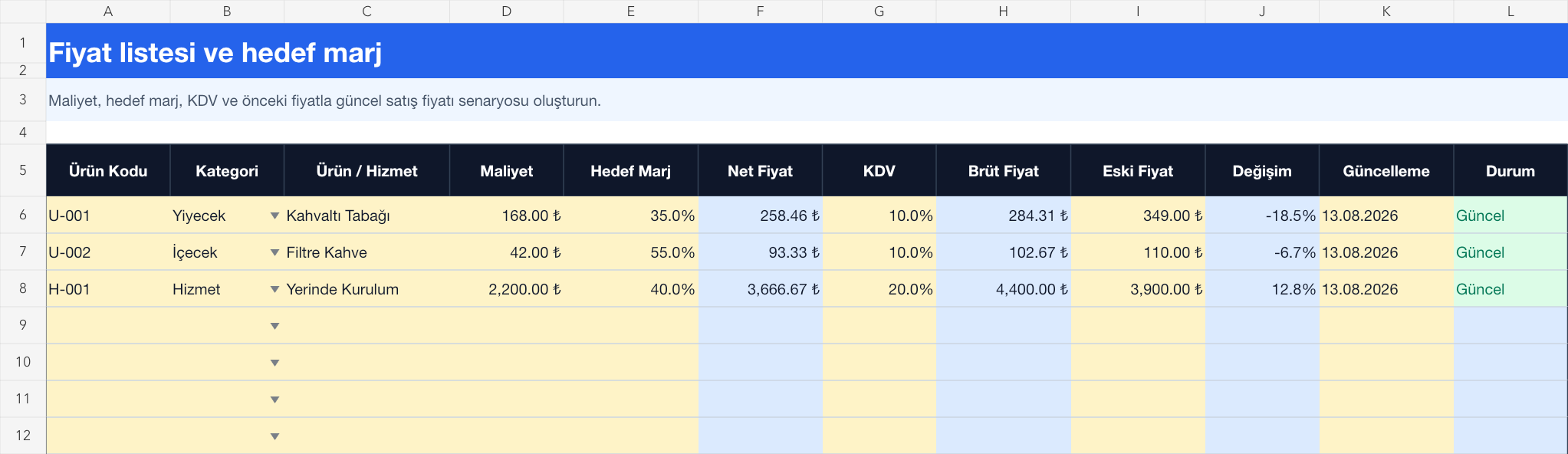
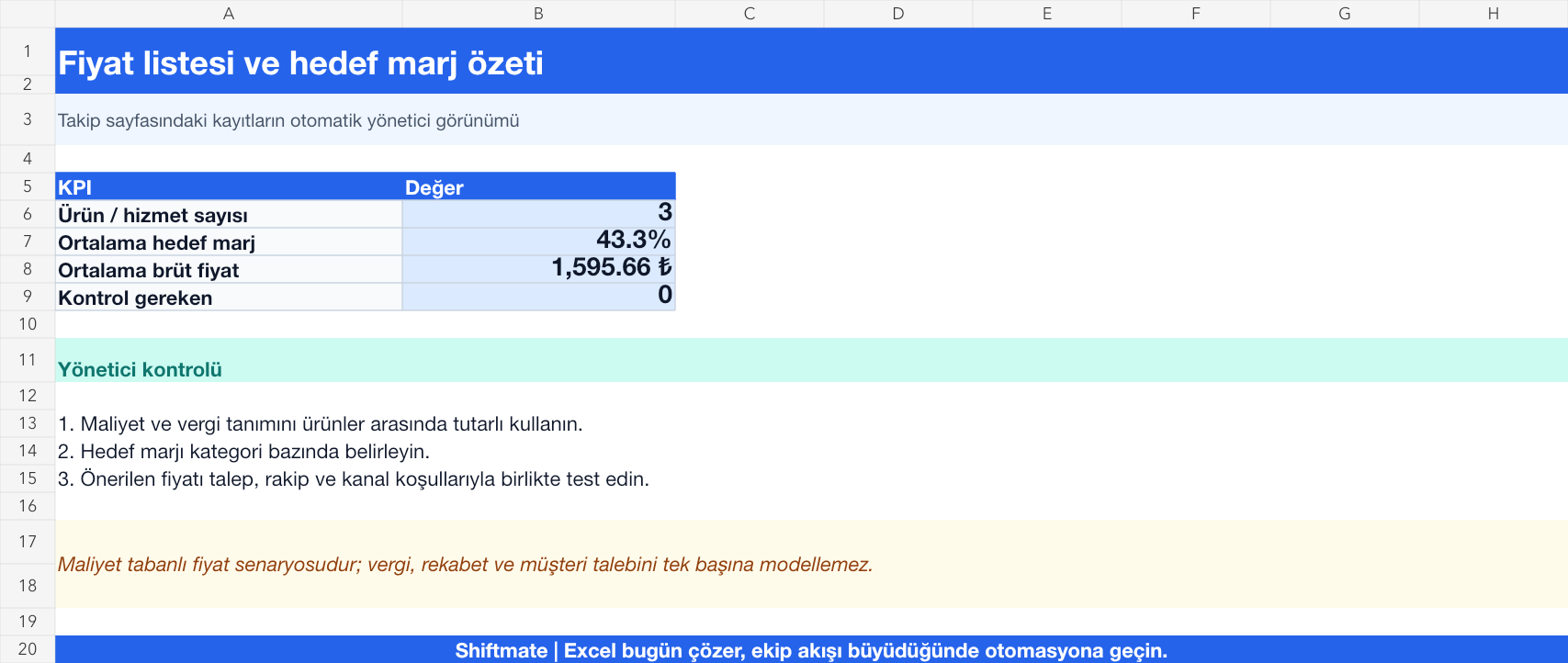
The images below are the actual data entry and executive summary pages of the workbook to be downloaded.
Step by step usage
Prepare the file according to your business
Enter the product code, product or service name, category, net cost, target gross margin, VAT rate, current price and last update date. Apply the same definition to all products as to which items are included in the cost.
Run formulas and checks
The target net selling price is the cost divided by one minus the target margin; The recommended price, including VAT, is calculated by increasing the net price with the tax rate. Compare the actual margin of the current price with the recommended value and check records that have not been updated for a long time.
Turn results into action
Review the indicators on the summary page. Identify products below target margin. Schedule price updates by channel and customer group. Store cost source and update date.
What does this Excel file solve?
Automatically calculate the sales price with target margin, price including VAT and update status from the product and service cost. Enter the product code, product or service name, category, net cost, target gross margin, VAT rate, current price and last update date. Apply the same definition to all products as to which items are included in the cost.
What's inside the file?
Cost and target margin, Recommended sales price, Price including VAT, Currentity control. The file contains sample rows, canned formulas, data validation fields, risk colorings, and executive summary.
Calculation and control logic
The target net selling price is the cost divided by one minus the target margin; The recommended price, including VAT, is calculated by increasing the net price with the tax rate. Compare the actual margin of the current price with the recommended value and check records that have not been updated for a long time.
Worked example: Price control after cost increase
Net cost: 900 TL. Target margin: 40%. VAT: 20%. Result: The target net price is 1,500 TL, the indicator including VAT becomes 1,800 TL; The manager evaluates the current price, competition and customer perception together.
Decisions that can be taken as a result of this
Identify products below target margin. Schedule price updates by channel and customer group. Store update date with cost source
Common usage mistakes
Assuming that the margin and the profit rate added to the cost are the same. Comparing the cost including VAT and the price excluding VAT. Removing discount and channel commission from the cost definition
Limits and proper use
The account generates suggestions; It does not model market demand, competitor price, contract, discount, commission and legal price display requirements. The final price requires business judgment and an up-to-date tax check.
Compatibility and quality control
All 67 workbooks underwent formula error scanning, recalculation checking, and page-by-page visual inspection. Standard .xlsx file; Does not contain macros or external links. Formulas and data validation fields run inside the file. It is recommended that you keep the original file and work on a separate copy for your business.
Transitioning from Excel to automation
Use the file to solve your small business operation need immediately. When registration and approval traffic grows, move the same process to the Shiftmate workspace.
Frequently asked questions
Is the profit margin and cost addition rate the same?
No. The margin is calculated based on the sales price, and the add-on ratio is calculated based on the cost. The template uses the target margin on the sales price; Do not write the two rates interchangeably.
Can service businesses use this price list?
Yes. Instead of the product cost, enter the consistent total of labor, materials, and other costs directly attributed to the service; Consider overhead costs separately.